
Internet, a system architecture that has revolutionized communications and methods of commerce by allowing various computer networks around the world to interconnect. Sometimes referred to as a “network of networks,” the Internet emerged in the United States in the 1970s but did not become visible to the general public until the early 1990s. By 2020, approximately 4.5 billion people, or more than half of the world’s population, were estimated to have access to the Internet.

origin of internet
computer networkWRITTEN BYMichael Aaron DennisSee All ContributorsIndependent scholar. Author of A Change of State: The Political Cultures of Technical Practice at the MIT Instrumentation Laboratory and the Johns Hopkins University Applied Physics Laboratory, 1930–1945.See Article History ARTICLE CONTENTS
Internet, a system architecture that has revolutionized communications and methods of commerce by allowing various computer networks around the world to interconnect. Sometimes referred to as a “network of networks,” the Internet emerged in the United States in the 1970s but did not become visible to the general public until the early 1990s. By 2020, approximately 4.5 billion people, or more than half of the world’s population, were estimated to have access to the Internet.
The Internet provides a capability so powerful and general that it can be used for almost any purpose that depends on information, and it is accessible by every individual who connects to one of its constituent networks. It supports human communication via social media, electronic mail (e-mail), “chat rooms,” newsgroups, and audio and video transmission and allows people to work collaboratively at many different locations. It supports access to digital information by many applications, including the World Wide Web. The Internet has proved to be a spawning ground for a large and growing number of “e-businesses” (including subsidiaries of traditional “brick-and-mortar” companies) that carry out most of their sales and services over the Internet. (See electronic commerce.)
Origin And Development
Early networks
The first computer networks were dedicated special-purpose systems such as SABRE (an airline reservation system) and AUTODIN I (a defense command-and-control system), both designed and implemented in the late 1950s and early 1960s. By the early 1960s computer manufacturers had begun to use semiconductor technology in commercial products, and both conventional batch-processing and time-sharing systems were in place in many large, technologically advanced companies. Time-sharing systems allowed a computer’s resources to be shared in rapid succession with multiple users, cycling through the queue of users so quickly that the computer appeared dedicated to each user’s tasks despite the existence of many others accessing the system “simultaneously.” This led to the notion of sharing computer resources (called host computers or simply hosts) over an entire network. Host-to-host interactions were envisioned, along with access to specialized resources (such as supercomputers and mass storage systems) and interactive access by remote users to the computational powers of time-sharing systems located elsewhere. These ideas were first realized in ARPANET, which established the first host-to-host network connection on October 29, 1969. It was created by the Advanced Research Projects Agency (ARPA) of the U.S. Department of Defense. ARPANET was one of the first general-purpose computer networks. It connected time-sharing computers at government-supported research sites, principally universities in the United States, and it soon became a critical piece of infrastructure for the computer science research community in the United States. Tools and applications—such as the simple mail transfer protocol (SMTP, commonly referred to as e-mail), for sending short messages, and the file transfer protocol (FTP), for longer transmissions—quickly emerged. In order to achieve cost-effective interactive communications between computers, which typically communicate in short bursts of data, ARPANET employed the new technology of packet switching. Packet switching takes large messages (or chunks of computer data) and breaks them into smaller, manageable pieces (known as packets) that can travel independently over any available circuit to the target destination, where the pieces are reassembled. Thus, unlike traditional voice communications, packet switching does not require a single dedicated circuit between each pair of users.
services offered by internet
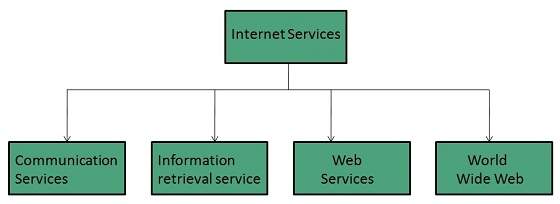
Internet Services allows us to access huge amount of information such as text, graphics, sound and software over the internet. Following diagram shows the four different categories of Internet Services.
Communication Services
There are various Communication Services available that offer exchange of information with individuals or groups. The following table gives a brief introduction to these services:S.N.Service Description1Electronic Mail
Used to send electronic message over the internet.2Telnet
Used to log on to a remote computer that is attached to internet.3Newsgroup
Offers a forum for people to discuss topics of common interests.4Internet Relay Chat (IRC)
Allows the people from all over the world to communicate in real time.5Mailing Lists
Used to organize group of internet users to share common information through e-mail.6Internet Telephony (VoIP)
Allows the internet users to talk across internet to any PC equipped to receive the call.7Instant Messaging
Offers real time chat between individuals and group of people. Eg. Yahoo messenger, MSN messenger.
Information Retrieval Services
There exist several Information retrieval services offering easy access to information present on the internet. The following table gives a brief introduction to these services:S.N.Service Description1File Transfer Protocol (FTP)
Enable the users to transfer files.2Archie
It’s updated database of public FTP sites and their content. It helps to search a file by its name.3Gopher
Used to search, retrieve, and display documents on remote sites.4Very Easy Rodent Oriented Netwide Index to Computer Achieved (VERONICA)
VERONICA is gopher based resource. It allows access to the information resource stored on gopher’s servers.
Web Services
Web services allow exchange of information between applications on the web. Using web services, applications can easily interact with each other.
The web services are offered using concept of Utility Computing.
World Wide Web (WWW)
WWW is also known as W3. It offers a way to access documents spread over the several servers over the internet. These documents may contain texts, graphics, audio, video, hyperlinks. The hyperlinks allow the users to navigate between the documents.
Video Conferencing
Video conferencing or Video teleconferencing is a method of communicating by two-way video and audio transmission with help of telecommunication technologies.
Modes of Video Conferencing
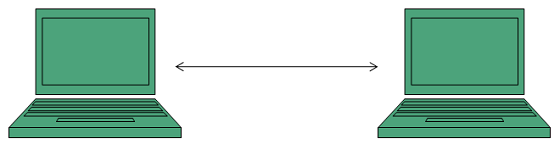
Point-to-Point
This mode of conferencing connects two locations only.
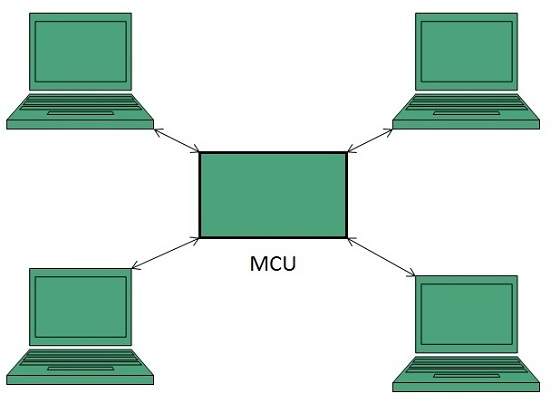
Multi-point
This mode of conferencing connects more than two locations through Multi-point Control Unit (MCU).
 F A C T S
hy
LikeLike